<?xml version="1.0" encoding="utf-8"?><feed xmlns="http://www.w3.org/2005/Atom" ><generator uri="https://jekyllrb.com/" version="3.10.0">Jekyll</generator><link href="https://jackdougherty.org/feed.xml" rel="self" type="application/atom+xml" /><link href="https://jackdougherty.org/" rel="alternate" type="text/html" /><updated>2026-02-18T10:57:48-05:00</updated><id>https://jackdougherty.org/feed.xml</id><title type="html">JackDougherty.org</title><subtitle>Let&apos;s make change more visible with data, maps, and digital storytelling</subtitle><author><name>Jack Dougherty</name></author><entry><title type="html"></title><link href="https://jackdougherty.org/2016-01-23-heq-teaching-forum/" rel="alternate" type="text/html" title="" /><published>2026-02-18T10:57:48-05:00</published><updated>2026-02-18T10:57:48-05:00</updated><id>https://jackdougherty.org/2016-01-23-heq-teaching-forum</id><content type="html" xml:base="https://jackdougherty.org/2016-01-23-heq-teaching-forum/"><![CDATA[<p>In Spring 2015, Nancy Beadie and Joy Williamson-Lott, as incoming editors of the <em><a href="http://onlinelibrary.wiley.com/journal/10.1111/(ISSN)1748-5959">History of Education Quarterly</a></em>, invited me and eight other colleagues to contribute essays for one of their new formats: a teaching forum. Their goal is to spark deeper reflections about our pedagogical thinking in the pages of this scholarly journal, which in past years has published mostly conventional research articles. The editors prompted us with a question — <em>how do we teach history with case studies?</em> — and pushed us to think about it as broadly as possible.</p>

<p>It wasn’t hard to persuade me to participate. I consider teaching to be central to my work, an intellectual exercise in pairing insightful questions with historical sources, closely watching and listening to how students learn, and continually rethinking the process for the next semester. But this group essay assignment also provided an opportunity to rethink how faculty engage in our work as writers. In the traditional mode, we submit our individual essays to editors, without necessarily see or having an opportunity to respond to what other authors are crafting for the same section. Yet this time, the HEQ editors accepted a suggested alternative: to encourage all of the contributors to share our drafts-in-progress in a Google Documents digital folder. This arrangement allowed each of our individual essays to benefit with constructive comments by our peers, and it also created more coherent conversation across our collective works. The key was to insert peer commentary into the <em>middle</em> of our writing process, rather than a traditional review of polished pieces at the end stage, to maximize the value of our feedback to one another.</p>

<p>The best way to understand this HEQ draft commentary process is to reveal the behind-the-scenes process, months before we arrived at the finished product. The examples pictured below feature comments that peers posted on different stages of my writing, because I am the “owner” of these digital drafts, and changed the sharing settings from private to public. I emailed my peers to ask if any wished to delete their comments on my public essay, and no one did. But I do not link to other drafts written by my peers, where many more comments appear, because they own their drafts, not me. If other forum participants wish to do so, they also can make their drafts public, share links and/or screenshots online, or ask me to include them in this essay.</p>

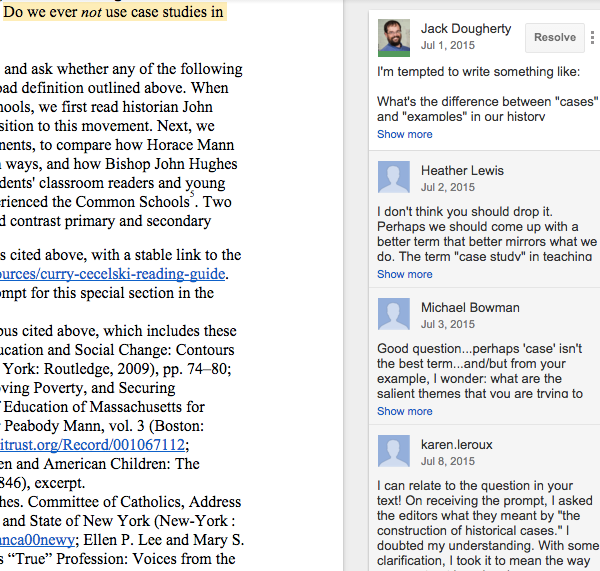
<p>The first draft I shared with the group appeared <a href="https://docs.google.com/document/d/10B7u3QQYZdPtE8I_jgU-U1llTjS3ONNA6msZVOZGCLI/edit">in this June 2015 Google Document</a>. Looking back, my writing was still in the discovery process. I began by describing a case study comparison in my class — an old one that I had written about elsewhere — but was still searching for the best way to express a new idea that had popped into my head. A few paragraphs into the essay, I rhetorically asked, “Do we ever <em>not</em> use case studies in our history teaching?” My inner skeptic had begun to challenge the writing prompt given to us by the editors, by questioning whether it was impossible to teach history without cases of some type. When we began to comment on each other’s drafts in early July, I noted my temptation to develop this theme further. Three other authors — Heather Lewis, Michael Bowman, and Karen Leroux — offered encouragement and constructive feedback, which shifted my approach. If they thought this half-baked idea had merit, perhaps I should frame it into a thesis and restructure the entire essay. Midway through the writing process, my peers inspired me to rethink and revise.</p>

<p><img src="/images/2016/Dougherty-HEQ-2015June.png" alt="heq june 2015 screenshot" />
<em>Excerpt of my first draft with peer comments, from my <a href="https://docs.google.com/document/d/10B7u3QQYZdPtE8I_jgU-U1llTjS3ONNA6msZVOZGCLI/edit">June 2015 Google Doc</a></em></p>

<p>A week later I rewrote the essay and shared it with the group in <a href="https://docs.google.com/document/d/183IX1ZtCfaj6LHJWQt7cJIVxE-kPGhScimhQyAGzsK8/edit">this July 2015 Google Document</a>. This newer version began with a stronger introductory argument and framework for four sections that followed about different types of cases in history teaching. But in this second round of commentary, my colleagues drew attention to some of my uncertain wording in the body of the essay, particularly the fourth section. When historians teach with role-playing scenarios, such as the highly-praised and widely popular “Reacting to the Past” series, does it favor conflict and competition over empathy and understanding? But that question wasn’t fully developed at the time. In this draft, authors Jon Hale, Ansley Erickson, and Isaac Gottesman posted comments that nudged me to clarify my not-yet-formed internal thoughts into clearer prose that others would understand. For authors who are stuck inside our own heads — something that happens to me quite often — their feedback allowed me to re-read my essay through their eyes, and re-word sentences to communicate more clearly.</p>

<p><img src="2016/Dougherty-HEQ-2015July.png" alt="heq july 2015 screenshot" />
<em>Excerpt of my second draft with peer comments, from this <a href="https://docs.google.com/document/d/183IX1ZtCfaj6LHJWQt7cJIVxE-kPGhScimhQyAGzsK8/edit">July 2015 Google Doc</a></em></p>

<p>No doubt, the last draft that I submitted in this <a href="https://docs.google.com/document/d/1u3A5JNGKJL2ZRy5DqPknXfoXwpNsMeeWrtWgM3jsWCI/edit">final August 2015 Google Document</a> is much stronger than what initially appeared months earlier on my computer screen. But the difference is that I received substantive peer feedback <em>during my writing process</em>, rather than solely at the end, when it’s often too late to significantly restructure and revise. Moreover, my essay became more refined and interconnected with the thinking of other authors because they shared their drafts and welcomed comments <em>at the same time</em> when I was writing and revising mine.</p>

<p>Memo to academic journal editors: If you want scholars to break out of our individual silos and communicate beyond our areas of specialization, then create more interdependent writing and commenting forums such as this one. Also, a memo to historians and other scholars: If the idea of sharing your drafts-in-progress with many colleagues sounds strange to you, then you need to get out of your office more often. Visit more classrooms, from kindergarten through college, that emphasize collaborative writing and peer editing. Read some of the ideas, examples, and tutorials featured in an open-access volume of essays I co-edited with Tennyson O’Donnell, <em><a href="http://webwriting.trincoll.edu">Web Writing: Why and How for Liberal Arts Teaching and Learning</a></em> (University of Michigan Press, 2015), or a related volume <em><a href="http://writinghistory.trincoll.edu">Writing History in the Digital Age</a></em>, co-edited with Kristen Nawrotzki (University of Michigan Press, 2013). Try teaching by assigning short essays where students have compelling reasons to share drafts and peer edit one another. Remember that technology is <em>not</em> the end goal, but rather, a tool that can help to restructure our traditionally isolated ways of writing in both teaching and scholarship.</p>

<p>If you want to read the full set of Teaching Forum essays, you’ll need to go to the <a href="http://onlinelibrary.wiley.com/doi/10.1111/hoeq.2016.56.issue-1/issuetoc">February 2016 issue of the <em>History of Education Quarterly</em></a>. Unfortunately, HEQ is published through a proprietary press with a subscriber-only site. At my campus, readers may need to log in through <a href="http://onlinelibrary.wiley.com.ezproxy.trincoll.edu/doi/10.1111/hoeq.2016.56.issue-1/issuetoc">this HEQ ezproxy.trincoll.edu link</a>, which requires a Trinity College username and password. Alas, HEQ does not yet belong to the growing number of <a href="https://doaj.org/">open-access scholarly journals</a>. Although my colleagues and I performed the bulk of the labor by writing and commenting on each other’s essays, the proprietary press makes a profit by selling our words, primarily back to our own non-profit academic institutions and our financially struggling libraries. But that’s a different rant, which I’ll save for another time . . .</p>]]></content><author><name>Jack Dougherty</name></author></entry><entry><title type="html"></title><link href="https://jackdougherty.org/2016-02-15-idp-open-house-2016/" rel="alternate" type="text/html" title="" /><published>2026-02-18T10:57:48-05:00</published><updated>2026-02-18T10:57:48-05:00</updated><id>https://jackdougherty.org/2016-02-15-idp-open-house-2016</id><content type="html" xml:base="https://jackdougherty.org/2016-02-15-idp-open-house-2016/"><![CDATA[<p>Trinity’s Individualized Degree Program for adult undergraduate students invited me and Claudia Malaga (IDP Class of 2015) to present to their Open House guests about collaborative knowledge creation in the liberal arts. Here’s a <a href="http://bit.ly/Dougherty-2016-02-15">direct link to our slides</a>.</p>]]></content><author><name>Jack Dougherty</name></author></entry><entry><title type="html"></title><link href="https://jackdougherty.org/2016-04-27-when-real-audiences/" rel="alternate" type="text/html" title="" /><published>2026-02-18T10:57:48-05:00</published><updated>2026-02-18T10:57:48-05:00</updated><id>https://jackdougherty.org/2016-04-27-when-real-audiences</id><content type="html" xml:base="https://jackdougherty.org/2016-04-27-when-real-audiences/"><![CDATA[<p><img src="/images/2016/2016-04-25-Educ308-Mitoma-Agosto.jpg" alt="guest evaluators" />
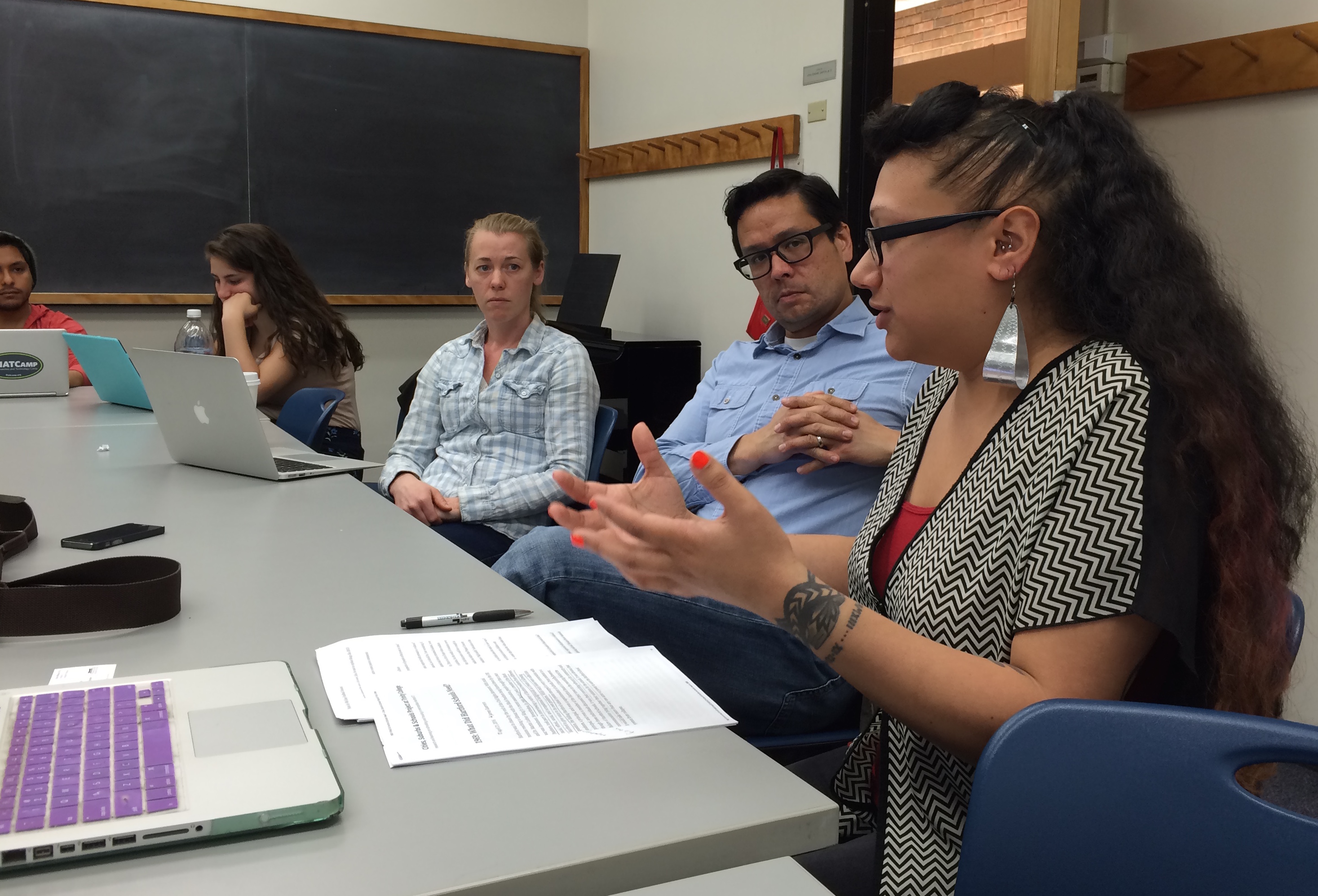
<em>Guest evaluators Jasmin Agosto (Trinity ‘10, right) and Glenn Mitoma (UConn, center) review their written feedback with student authors in the Cities Suburbs and Schools seminar.</em></p>

<p>This week we wrapped up one of the most meaningful writing exercises this semester in my <a href="http://commons.trincoll.edu/cssp/seminar/">Cities Suburbs and Schools seminar</a>. Rather than typing up a traditional paper to be read only by their professor, Trinity students composed essays on the public web, received feedback on early drafts from our “sister seminar” at Yale University, and final evaluations from a panel of three guest evaluators. Based on similar assignments over the past several years, students work harder on improving their prose — and find the experience to be more intrinsically rewarding — when real audiences are involved in the writing process.</p>

<p>Earlier this month, students carved out their topics and digitized source materials from a list of topics on the recent history of education and activism in the Hartford region. The assignment was to tell a compelling story, with analytical insight and supporting evidence, of no more than 2,500 words, for audiences who may be unfamiliar with the issue. Topics included the 1960s Project Concern city-suburban integration program, the 1969 Hartford documentary film interviews, the 1970s Lumpkin school desegregation case, the 1985 Bloomfield school residency case, and plaintiffs’ perspectives in the 1989 Sheff integration case. This seminar had the advantage of drawing on source materials that previous students had already collected and digitized, so that we could focus more of our energy on the analysis and storytelling. See the students’ web essays at: <a href="http://commons.trincoll.edu/cssp/web-essays/">http://commons.trincoll.edu/cssp/web-essays/</a>. Also, to learn more about the philosophy and planning behind this pedagogical approach, see my essays on related examples in the <a href="http://webwriting.trincoll.edu"><em>Web Writing</em> book</a> and a recent <a href="http://ontheline.trincoll.edu"><em>Connecticut History Review</em> article</a>.</p>

<p>Many thanks to Mira Debs for teaching her <a href="https://citiessuburbsschoolchoice.wordpress.com/">Yale University “sister seminar”</a> on a similar topic for her students who exchanged drafts and peer comments with us via Google Docs this semester. Also, a special thanks to our three guest evaluators — Jasmin Agosto (Trinity ’10), Glenn Mitoma (UConn), and Susan Campbell (U of New Haven) — who recognized the strengths of the students’ work and recommended ways to further revise it for potential publication in the <em><a href="http://ontheline.trincoll.edu">On The Line</a></em> book that I’m currently writing with several contributors.</p>

<p>Although this specific class assignment has concluded, one way to judge the depth of student learning is to follow how many choose to revise their drafts again — without grades as a motivator — to improve our telling of these important civil rights education stories with broader audiences.</p>]]></content><author><name>Jack Dougherty</name></author></entry><entry><title type="html">Which Legislative Districts have School Based Health Centers?</title><link href="https://jackdougherty.org/2025/12/16/school-health-equity/" rel="alternate" type="text/html" title="Which Legislative Districts have School Based Health Centers?" /><published>2025-12-16T00:00:00-05:00</published><updated>2025-12-16T00:00:00-05:00</updated><id>https://jackdougherty.org/2025/12/16/school-health-equity</id><content type="html" xml:base="https://jackdougherty.org/2025/12/16/school-health-equity/"><![CDATA[<p>Our partner organization, <a href="https://ctschoolhealth.org/">CASBHC: The Connecticut Association of School Based Health Centers</a>, advocates for medical, dental, and mental health services that are offered at no cost to students in over 300 public schools across the state. But they needed help answering questions for the next phase of their healthy equity work. First, which CT public schools do <em>not</em> have these centers, and how do their student demographics compare to schools that have them? Second, how many of these school based health centers are located in each state legislator’s district? Students in my <a href="https://datavizforall.org/partners-projects/#school-based-health-centers">Data Visualization for All class in Fall 2025</a> answered these questions. First, we linked CASBHC’s dataset of 300+ school based health centers to a larger CT Department of Education dataset of over 2000 public schools and programs, along with student enrollment data by grade, race, and social class. Second, students such as <a href="https://datavizforall.org/schools-conard-mehran-lodge/">Emma Conard and Darian Mehran-Lodge</a> spatially joined the location of each school to state legislative boundaries, to map political power and state funding that currently supports school based health centers.</p>

<figure class="align-center" style="width:80%;"><img src="/images/2025/school-health-centers-map.png" alt="school health center map" /><figcaption>
      Learn about school based health centers and legislative districts in <a href="https://datavizforall.org/schools-conard-mehran-lodge/">data story by Emma Conard and Darian Mehran-Lodge</a>

    </figcaption></figure>

<figure class="align-center" style="width:80%;"><img src="/images/2025/school-health-equity-class-photo.jpg" alt="school health equity class photo" /><figcaption>
      Students in the <a href="https://datavizforall.org/partners-projects/#school-based-health-centers">School Health Equity dataviz team</a>

    </figcaption></figure>]]></content><author><name>Jack Dougherty</name></author><category term="education" /><category term="Hartford" /><category term="data visualization" /><category term="advocacy" /><category term="teaching" /><category term="community engagement" /><category term="Educational Studies" /><category term="Trinity College" /><summary type="html"><![CDATA[Our partner organization supports for over 300 school based health centers across Connecticut. But which schools do *not* have these centers? And how many are located in each state legislator's district?]]></summary></entry><entry><title type="html">Comparing School Finance Equity in MA vs CT</title><link href="https://jackdougherty.org/2025/12/15/school-finance-ma-ct/" rel="alternate" type="text/html" title="Comparing School Finance Equity in MA vs CT" /><published>2025-12-15T00:00:00-05:00</published><updated>2025-12-15T00:00:00-05:00</updated><id>https://jackdougherty.org/2025/12/15/school-finance-ma-ct</id><content type="html" xml:base="https://jackdougherty.org/2025/12/15/school-finance-ma-ct/"><![CDATA[<p>Our partners at the <a href="https://schoolstatefinance.org/about/our-team">School + State Finance Project</a> asked my <a href="https://datavizforall.org/partners-projects/#school-finance-inequality">Trinity College students in Fall 2025</a> to create data visualizations to compare school finance equity between Connecticut and Massachusetts. My students created data stories with interactive charts and maps to answer questions such as: How does school spending per student vary across states when factoring in different costs of living? Do CT and MA school districts have equitable spending based on the racial background or multi-language learner status of students? On the latter question, Trinity students <a href="https://datavizforall.org/schools-fearon-nelson/">Rachel Fearon and Ashley Nelson found</a> that MA districts have a slightly <em>positive</em> trend of spending on higher percentages of multi-language learners, while CT districts have a slightly <em>negative</em> trend in the opposite direction, as shown in the comparative scatter charts below.</p>

<figure class="align-center" style="width:80%;"><img src="/images/2025/education-ma-ct.jpg" alt="MA and CT scatter charts" /><figcaption>
      Learn more in <a href="https://datavizforall.org/schools-fearon-nelson/">data story by Rachel Fearon and Ashley Nelson</a>

    </figcaption></figure>

<figure class="align-center" style="width:80%;"><img src="/images/2025/school-finance-class-photo.jpg" alt="school finance class photo" /><figcaption>
      Students in the <a href="https://datavizforall.org/partners-projects/#school-finance-inequality">School Finance Equity dataviz team</a>

    </figcaption></figure>]]></content><author><name>Jack Dougherty</name></author><category term="education" /><category term="Boston" /><category term="Hartford" /><category term="data visualization" /><category term="advocacy" /><category term="teaching" /><category term="community engagement" /><category term="Educational Studies" /><category term="Trinity College" /><summary type="html"><![CDATA[Our partners at the School + State Finance Project asked us to create data visualizations to compare school finance equity between Connecticut and Massachusetts.]]></summary></entry><entry><title type="html">Teaching My Last Class at Trinity College</title><link href="https://jackdougherty.org/2025/12/03/last-class/" rel="alternate" type="text/html" title="Teaching My Last Class at Trinity College" /><published>2025-12-03T00:00:00-05:00</published><updated>2025-12-03T00:00:00-05:00</updated><id>https://jackdougherty.org/2025/12/03/last-class</id><content type="html" xml:base="https://jackdougherty.org/2025/12/03/last-class/"><![CDATA[<p>Students joined me to celebrate my last two class sessions after 26 years of teaching at Trinity College (1999-2025). This fall I taught two back-to-back sections of <a href="https://datavizforall.org">Educ 206: Data Visualization for All</a>, where we partnered with two CT non-profit organizations to create data stories with interactive charts and maps. I’m very pleased that every student in both classes completed their online data stories, attended our final in-person class, and decided to join me in front of the camera with smiles! I’m very proud to have finished on a high note, with several of my students producing some of the highest-quality data stories during my time teaching this course. Next week they deliver two-minute highlights of their data stories and participate in Q&amp;A with a panel of guest experts on Zoom. Now I’m ready to #FlunkRetirement by starting up new projects with community groups in my new home in Boston.</p>

<p><img src="/images/2025/last-class-combo.jpg" alt="last class" /></p>]]></content><author><name>Jack Dougherty</name></author><category term="teaching" /><category term="Educational Studies" /><category term="Trinity College" /><category term="Hartford" /><category term="community engagement" /><category term="data visualization" /><summary type="html"><![CDATA[Students joined me to celebrate my last two class sessions after 26 years of teaching at Trinity College (1999-2025). This fall I taught two back-to-back sections of Educ 206: Data Visualization for All, where we partnered with two CT non-profit organizations to create data stories with interactive charts and maps. I’m very pleased that every student in both classes completed their online data stories, attended our final in-person class, and decided to join me in front of the camera with smiles! I’m very proud to have finished on a high note, with several of my students producing some of the highest-quality data stories during my time teaching this course. Next week they deliver two-minute highlights of their data stories and participate in Q&amp;A with a panel of guest experts on Zoom. Now I’m ready to #FlunkRetirement by starting up new projects with community groups in my new home in Boston.]]></summary></entry><entry><title type="html">Safer Streets Advocacy with Short Videos</title><link href="https://jackdougherty.org/2025/05/01/streets-bwh-short-videos/" rel="alternate" type="text/html" title="Safer Streets Advocacy with Short Videos" /><published>2025-05-01T00:00:00-04:00</published><updated>2025-05-01T00:00:00-04:00</updated><id>https://jackdougherty.org/2025/05/01/streets-bwh-short-videos</id><content type="html" xml:base="https://jackdougherty.org/2025/05/01/streets-bwh-short-videos/"><![CDATA[<p>To make problems and solutions more publicly visible, street safety advocates and I created several on-site short videos for social media channels in West Hartford, Connecticut. Our most successful short videos featured urban planners and parents who spoke directly to the camera to share their first-hand perspectives, with on-screen graphics to emphasize their points. We shot video with smartphones and <a href="https://rode.com/en-us/products/wireless-micro">Rode wireless microphones</a> for clearer outdoor narration, and edited in Canva, a tool already familiar to the organization, to quickly produce one-minute shorts for social media and newsletters. See this <a href="https://bikewesthartford.org/mary-donegan-draft-plan/">June 2024 video</a> and <a href="https://bikewesthartford.org/parents-want-more-raised-crosswalks-in-west-hartford/">May 2025 video</a> with context by Bike West Hartford.</p>

<!-- Courtesy of embedresponsively.com -->

<div class="responsive-video-container">
    <iframe src="https://www.youtube-nocookie.com/embed/_MB-zEp4bWo" frameborder="0" webkitallowfullscreen="" mozallowfullscreen="" allowfullscreen=""></iframe>
  </div>

<!-- Courtesy of embedresponsively.com -->

<div class="responsive-video-container">
    <iframe src="https://www.youtube-nocookie.com/embed/3WAnUCXiL18" frameborder="0" webkitallowfullscreen="" mozallowfullscreen="" allowfullscreen=""></iframe>
  </div>]]></content><author><name>Jack Dougherty</name></author><category term="streets" /><category term="storytelling" /><category term="Hartford" /><category term="advocacy" /><category term="policy" /><summary type="html"><![CDATA[To make problems and solutions more publicly visible, street safety advocates and I created several on-site short videos for social media channels in West Hartford, Connecticut.]]></summary></entry><entry><title type="html">Rejecting Kings Since 1776</title><link href="https://jackdougherty.org/2025/02/23/rejecting-kings/" rel="alternate" type="text/html" title="Rejecting Kings Since 1776" /><published>2025-02-23T00:00:00-05:00</published><updated>2025-02-23T00:00:00-05:00</updated><id>https://jackdougherty.org/2025/02/23/rejecting-kings</id><content type="html" xml:base="https://jackdougherty.org/2025/02/23/rejecting-kings/"><![CDATA[<p><em>Originally posted February 23rd 2025. Updated April 5th; May 29th.</em></p>

<p><strong>Updated May 29th:</strong> <em>While you can still print your own (see below), individual “Rejecting Kings” lawn signs are <a href="https://cricketpress.net/products/no-kings-yard-sign">now available for sale at Cricket Press</a>, 236 Park Road, West Hartford CT (next to AC Peterson’s ice cream), phone 860-521-9279 or email info@cricketpress.net. We intentionally published the sign with “public domain” licensing, so anyone can print it. We do not set the price nor make any money. We just want to spread the word: #NoKings!</em></p>

<p>Sometimes, getting angry motivates you to get stuff done. Tonight my spouse Beth Rose and I designed a lawn sign, our small way to speak out against Trump’s monarchical words and actions, with a flag-centric message to remind everyone of our nation’s united stance for democracy. After all, what’s more American than “Rejecting Kings” since the July 4th Declaration of Independence?</p>

<figure class="align-center" style="width:60%;"><img src="/images/2025/rejecting-kings.jpg" alt="" /><figcaption>
      Rejecting Kings Since 1776 (Even Earlier in Connecticut). Download public <a href="/images/2025/rejecting-kings.pdf">PDF link</a> or <a href="https://www.canva.com/design/DAGf-BEoG_w/w2hOEGX-mQ0cvTXDXJvL9g/edit?utm_content=DAGf-BEoG_w&amp;utm_campaign=designshare&amp;utm_medium=link2&amp;utm_source=sharebutton">Canva link</a>

    </figcaption></figure>

<p>We publicly shared the <a href="/images/2025/rejecting-kings.pdf">PDF link</a> and <a href="https://www.canva.com/design/DAGf-BEoG_w/w2hOEGX-mQ0cvTXDXJvL9g/edit?utm_content=DAGf-BEoG_w&amp;utm_campaign=designshare&amp;utm_medium=link2&amp;utm_source=sharebutton">Canva link</a> for people to download and print their own, or modify as they wish. Both are shared under a <a href="https://creativecommons.org/publicdomain/zero/1.0/">CC0 Public Domain license</a> to encourage wide distribution.</p>

<p>The asterisk with the historical footnote was Beth’s idea. Many state residents have heard the <a href="https://connecticuthistory.org/the-legend-of-the-charter-oak/">Legend of Connecticut’s Charter Oak of 1687</a>. When England’s King James II sought to reassert control over the colony, he appointed a new governor to confiscate the previous charter that had granted self-governance. Allegedly, during a nighttime debate at Old State House in Hartford, opponents of the King’s rule blew out the candles and whisked away the charter document to hide it inside a large hollow oak tree, later known as the “Charter Oak.”</p>

<p>But Beth (and our neighbor Bill) also taught me that anti-monarchy sentiment goes back even earlier. <a href="https://todayincthistory.com/2020/03/07/march-7-english-regicides-flee-to-new-haven-2/">Connecticut played a key role in hiding three judges involved in the 1649 Regicide</a>, when 59 English Puritan judges put King Charles I on trial for tyranny against their nation, found him guilty, and signed the death warrant for his execution. After a turbulent decade, pro-monarchy forces restored his son to the throne as King Charles II, who sought vengeance against the Puritan “regicides,” or king killers. Eventually, three of them – Edward Whalley, William Goffe, and John Dixwell – fled to New Haven, Connecticut, where two of them temporarily lived in the West Rock area currently known as “Judges’ Cave”. Three major roads bear their names.</p>

<figure class="align-center" style="width:90%;"><img src="/images/2025/todayincthistory-regicides-roads.jpg" alt="" /><figcaption>
      New Haven’s Whalley, Goffe, and Dixwell Avenues were named after the Regicide fugitives. Photo from <a href="https://todayincthistory.com/2020/03/07/march-7-english-regicides-flee-to-new-haven-2/">West Rock Trails blog/Today in CT History</a>

    </figcaption></figure>

<p>So in late February, we took our design to a local print shop and ordered 50 lawn signs. We posted two on our corner lot, snapped a cute pic with Oscar the dog peeking through the fence, and circulated our offer to neighbors and friends, asking $10 donation to cover our printing costs. Our front porch became a small cottage industry for people to pick up their signs, tagged with their names on blue masking tape. The neighborhood started to bloom with spring flowers and lawn signs. Our first batch sold out in one week.</p>

<figure class="align-center" style="width:90%;"><img src="/images/2025/rejecting-kings-collage1.jpg" alt="" /><figcaption>
      Oscar has made many new friends as our top sales dog.

    </figcaption></figure>

<p>Beth and I thought we were done, but our neighbors Amy and Lydia kindly fronted most of the cash for a second batch of 100 signs. During the month of March into early April, our “Rejecting Kings” design became even more popular. Historian <a href="https://bsky.app/profile/hcrichardson.bsky.social">Heather Cox Richardson</a> liked our neighbor Adam’s photo of the sign on social media, which gained over a thousand likes. At the <a href="https://ctmirror.org/2025/03/18/ct-national-day-of-action-medicaid/">Medicaid Day of Action Rally</a> at the Connecticut State Capitol, a patriot held the sign directly behind Governor Ned Lamont while he spoke at the podium. Rather than picking up one or two signs, some people placed orders for five or ten signs to share with their neighbors. Oscar took the opportunity to make many new friends on our porch.</p>

<p>And yes, because this is America, some people began using our public domain image to sell online merchandise – shirts, stickers, banners – with computer-generated models. But that’s perfectly fine. Beth and I intentionally shared our design to speak out, in our own small way, to better our nation.</p>

<figure class="align-center" style="width:90%;"><img src="/images/2025/rejecting-kings-collage2.jpg" alt="" /><figcaption>
      Our ‘Rejecting Kings’ sign became popular on social media, at protest events, and in other people’s for-profit merchandising. Middle photo of CT Gov. Lamont by Shahrzad Rasekh/CT Mirror.

    </figcaption></figure>

<p>Today, Beth and I brought our last fifteen signs to the <a href="https://ctmirror.org/2025/04/05/ct-hands-off-protests/">Hands Off Day of Action</a> against Trump at the CT State Capitol. Despite the rain, this protest event had a very strong turnout. We took pride in seeing several people bring the signs we designed to the event, and quickly sold out our remaining stock. Feels good that our “Rejecting Kings” message resonated with so many people. Let’s keep working together to make the change we need.</p>

<figure class="align-center" style="width:90%;"><img src="/images/2025/rejecting-kings-collage3.jpg" alt="" /><figcaption>
      Sold our remaining signs and saw many people bring them to the April 5th protest. Photos by Beth K.

    </figcaption></figure>

<p>Several folks have already asked: Do you have more signs? Beth and I do not plan to order another batch unless friends wish to help front the $1k cost for 100 more at $10 each. Or anyone can download the design and print their own using the links at the top of this page.</p>]]></content><author><name>Jack Dougherty</name></author><category term="advocacy" /><category term="history" /><summary type="html"><![CDATA[Originally posted February 23rd 2025. Updated April 5th; May 29th.]]></summary></entry><entry><title type="html">Mapping 30 Years of Affordable Homeownership with CLJ</title><link href="https://jackdougherty.org/2024/12/15/mapping-30-years-clj/" rel="alternate" type="text/html" title="Mapping 30 Years of Affordable Homeownership with CLJ" /><published>2024-12-15T00:00:00-05:00</published><updated>2024-12-15T00:00:00-05:00</updated><id>https://jackdougherty.org/2024/12/15/mapping-30-years-clj</id><content type="html" xml:base="https://jackdougherty.org/2024/12/15/mapping-30-years-clj/"><![CDATA[<p>To help preserve affordable homeownership, we mapped one of the oldest and largest shared equity land trust housing programs in the Northeastern US, in partnership with the <a href="https://cljct.org">Center for Leadership and Justice</a> (CLJ) in Hartford CT. Shared equity land trusts, also known as <a href="https://groundedsolutions.org/strengthening-neighborhoods/community-land-trusts/">community land trusts</a>, allow lower-income buyers to purchase a home while the trust maintains ownership of the land to block speculators and assure that future resale prices remain affordable. As a class project for my <a href="https://datavizforall.org">Data Visualization for All</a> course in Fall 2024, students and I cleaned up CLJ’s dataset of 211 properties in this 30-year-old homeownership program, and linked the data to present-day public assessor records to analyze trends. Nellie Conklin published <a href="https://datavizforall.org/clt-conklin/">her data story</a> that mapped the general location of these single- and multi-family properties in the Hartford region, and compared CLJ’s program to similar homeownership initiatives across the Northeast. CLJ staff worked with Conklin to <a href="https://cljct.org/usa/">republish her map on their website</a>. Note: to maintain privacy for individual homeowners, as requested by CLJ, we masked street addresses and removed zoom controls <a href="https://datawrapper.dwcdn.net/k8d6H/1/">in the map below</a>.</p>

<iframe title="The Five Towns With The Greatest Number of USA Homes" aria-label="Symbol map" id="datawrapper-chart-k8d6H" src="https://datawrapper.dwcdn.net/k8d6H/1/" scrolling="no" frameborder="0" style="width: 0; min-width: 100% !important; border: none;" height="773" data-external="1"></iframe>
<script type="text/javascript">window.addEventListener("message",function(a){if(void 0!==a.data["datawrapper-height"]){var e=document.querySelectorAll("iframe");for(var t in a.data["datawrapper-height"])for(var r,i=0;r=e[i];i++)if(r.contentWindow===a.source){var d=a.data["datawrapper-height"][t]+"px";r.style.height=d}}});</script>

<p>To learn how <a href="/coaching/">digital strategy coaching</a> can help your community organization, <a href="mailto:jack@jackdougherty.org">email me</a> or schedule a free 30-minute Zoom meeting <a href="/calendar/">on my calendar</a>.</p>]]></content><author><name>Jack Dougherty</name></author><category term="housing" /><category term="Hartford" /><category term="data visualization" /><category term="teaching" /><category term="Educational Studies" /><category term="Trinity College" /><category term="community engagement" /><summary type="html"><![CDATA[To preserve affordable homeownership, we mapped one of the oldest and largest shared equity land trust housing programs in the Northeastern US, in partnership with the Center for Leadership and Justice in Hartford CT.]]></summary></entry><entry><title type="html">Charting 30 Years of Affordable Home Prices with CLJ</title><link href="https://jackdougherty.org/2024/12/14/charting-30-years-clj/" rel="alternate" type="text/html" title="Charting 30 Years of Affordable Home Prices with CLJ" /><published>2024-12-14T00:00:00-05:00</published><updated>2024-12-14T00:00:00-05:00</updated><id>https://jackdougherty.org/2024/12/14/charting-30-years-clj</id><content type="html" xml:base="https://jackdougherty.org/2024/12/14/charting-30-years-clj/"><![CDATA[<p>In partnership with the <a href="https://cljct.org">Center for Leadership and Justice in Hartford CT</a>, we tracked the effectiveness of their shared equity land trust program, Urban Suburban Affordables Inc., one of the oldest and largest home ownership programs of its type in the Northeastern US. Shared equity land trusts, also known as <a href="https://groundedsolutions.org/strengthening-neighborhoods/community-land-trusts/">community land trusts</a>, allow lower-income buyers to purchase a home while the trust maintains ownership of the land to block speculators and assure that future resale prices remain affordable. As a class project for my <a href="https://datavizforall.org">Data Visualization for All</a> course in Fall 2024, students and I cleaned up CLJ’s dataset of 211 properties in this 30-year-old homeownership program, and linked the data to public assessor records to analyze trends. Teams of students, such as <a href="https://datavizforall.org/clt-safy-almukhtar/">Jana Safy and Hameed Almukhtar</a>, published data stories to highlight their findings with data visualizations. The co-authors tracked the sales transactions of a sample of 20 single-family shared equity land trust homes in Hartford since they were acquired beginning in the early 1990s. The median value of homes in this sample rose 253 percent over time, as shown by the blue line <a href="https://www.datawrapper.de/_/McBh3/">in the chart below</a>. In addition, Safy and Almukhtar found that the median value of this sample of shared equity trust homes did not rise as fast as typical home sales in the region during the same time period. Overall, their finding supports CLJ’s efforts to support local homeownership while keeping resale prices affordable for the next generation of lower-income buyers.</p>

<iframe title="Median Value Rose 253% of Shared Equity Land Trust Homes in Hartford Sample Over Time" aria-label="Line chart" id="datawrapper-chart-McBh3" src="https://datawrapper.dwcdn.net/McBh3/1/" scrolling="no" frameborder="0" style="width: 0; min-width: 100% !important; border: none;" height="378" data-external="1"></iframe>
<script type="text/javascript">window.addEventListener("message",function(a){if(void 0!==a.data["datawrapper-height"]){var e=document.querySelectorAll("iframe");for(var t in a.data["datawrapper-height"])for(var r,i=0;r=e[i];i++)if(r.contentWindow===a.source){var d=a.data["datawrapper-height"][t]+"px";r.style.height=d}}});</script>

<p>To learn how <a href="/coaching/">digital strategy coaching</a> can help your community organization, <a href="mailto:jack@jackdougherty.org">email me</a> or schedule a free 30-minute Zoom meeting <a href="/calendar/">on my calendar</a>.</p>]]></content><author><name>Jack Dougherty</name></author><category term="housing" /><category term="Hartford" /><category term="data visualization" /><category term="teaching" /><category term="Educational Studies" /><category term="Trinity College" /><category term="community engagement" /><summary type="html"><![CDATA[To track the effectiveness of an affordable home ownership program, we researched and tracked home prices during its first 30 years and compared them to nearby homes, in partnership with the Center for Leadership and Justice in Hartford CT.]]></summary></entry></feed>